
Key Takeaways
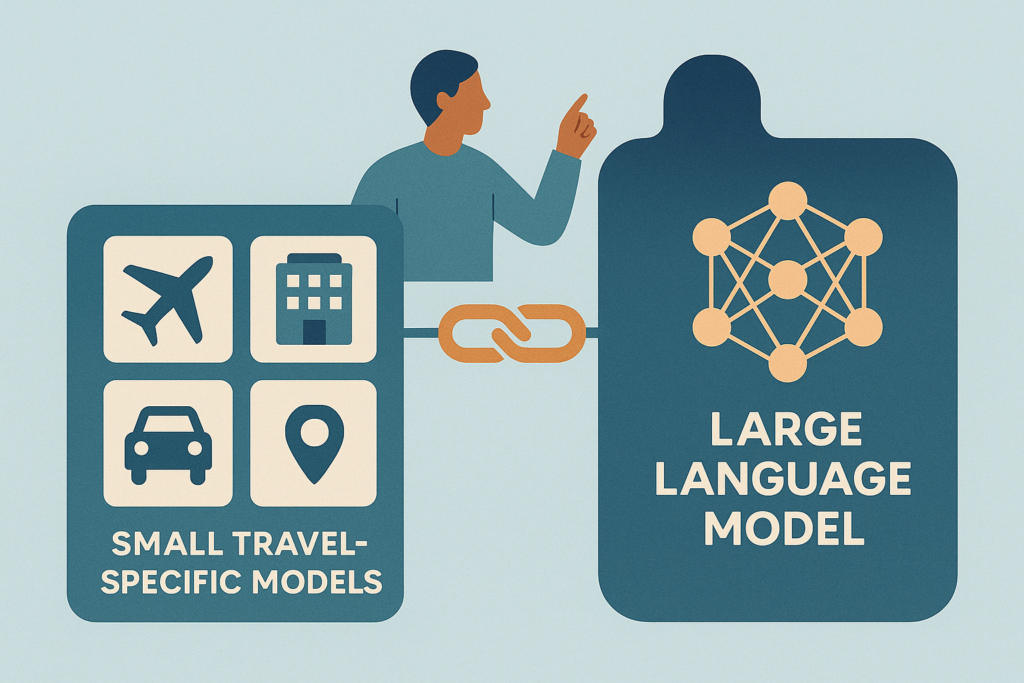
- Booking.com uses a hybrid AI strategy with small travel-specific models and larger language models.
- The company collaborates with OpenAI to achieve double accuracy in key tasks.
- Booking.com focuses on personalized filtering and customer context.
- The strategy balances between general and specialized AI agents.
- Flexibility and reversible decisions are central to their approach.
A Disciplined Approach to AI
Booking.com has adopted a disciplined, modular AI strategy, focusing on small, travel-specific models for quick inference and larger language models (LLMs) for complex reasoning. This approach, combined with selective collaboration with OpenAI, has led to a doubling of accuracy in retrieval, ranking, and customer-interaction tasks.
Balancing General and Specialized Agents
Pranav Pathak, Booking.com’s AI product development lead, discusses the balance between building specialized agents and maintaining a few generalized ones. The company aims to keep agent design flexible, allowing for reversible decisions and avoiding long-term commitments that could become costly.
Enhancing Personalization
Moving Beyond Guessing
Traditional recommendation systems often rely on guessing rather than true personalization. Booking.com aims to change this by basing recommendations on customer context, improving customer service and retention.
Personalized Filtering
To enhance personalization, Booking.com introduced a free text box for tailored search filters, revealing customer preferences such as the demand for hot tubs, which was previously unconsidered.
Managing Memory and Privacy
Pathak emphasizes the importance of managing customer memory with consent to avoid being perceived as intrusive. Booking.com seeks to retain useful customer information while respecting privacy.
Building Versus Buying
Booking.com evaluates whether to build or buy AI solutions based on use cases. They generalize where possible and specialize when necessary, ensuring high accuracy and output quality.
Flexibility in Monitoring
The company uses a flexible approach for monitoring and evaluations, buying general-purpose solutions and building in-house tools when brand guidelines are critical.
Lessons for Other Enterprises
Booking.com’s AI journey offers lessons for other businesses. Pathak advises starting with simple solutions and leveraging out-of-the-box APIs before moving to more complex customizations. Avoid locking into decisions too early, and ensure solutions align with long-term goals.
FAQ
What is Booking.com’s AI strategy?
Booking.com uses a modular AI strategy with small travel-specific models and larger language models, collaborating with OpenAI to enhance accuracy.
How does Booking.com personalize its services?
The company uses personalized filtering and bases recommendations on customer context to improve service and retention.
What advice does Booking.com offer to other businesses?
Start with simple solutions, use out-of-the-box APIs, and avoid making irreversible decisions too early.
Closing Summary
Booking.com’s approach to AI offers valuable insights for businesses seeking to enhance their systems. By balancing general and specialized solutions and focusing on flexibility, companies can improve accuracy and personalization while maintaining customer trust.
Source: Booking.com’s agent strategy: Disciplined, modular and already delivering 2× accuracy – venturebeat.com