
Key Takeaways
- V-JEPA is an AI model developed by Meta that learns physical intuition from videos.
- It uses latent representations to focus on essential details, avoiding unnecessary pixel data.
- The model demonstrates a notion of ‘surprise’ when encountering unexpected events.
- V-JEPA shows promise in applications like autonomous robotics.
Understanding V-JEPA
V-JEPA, developed by Meta, is an AI model designed to learn about the physical world by watching videos. Unlike traditional models that focus on individual pixels, V-JEPA uses higher-level abstractions, known as latent representations, to understand the content. This approach allows the model to concentrate on important aspects, such as the presence of cars, while ignoring irrelevant details like moving leaves.
How It Works
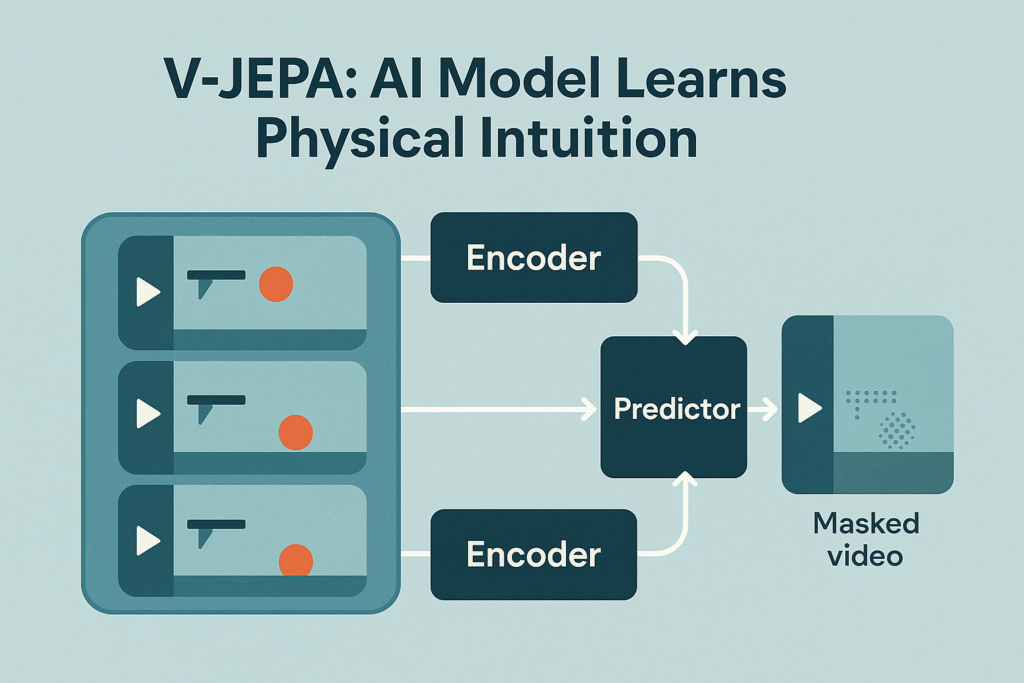
The V-JEPA architecture consists of three main components:
- Encoder 1: Converts masked video frames into latent representations.
- Encoder 2: Processes unmasked frames into another set of latent representations.
- Predictor: Uses latent representations from Encoder 1 to predict those from Encoder 2.
This process enables V-JEPA to learn the essential features of its environment, facilitating tasks such as classifying images and identifying actions in videos.
Performance and Applications
V-JEPA has demonstrated impressive capabilities in understanding intuitive physical properties, such as object permanence and gravity. In tests like IntPhys, it achieved nearly 98% accuracy in identifying physically plausible events. This performance is crucial for applications in autonomous robotics, where understanding physical interactions is essential.
Future Developments
The latest iteration, V-JEPA 2, has been pretrained on 22 million videos and applied to robotics. Despite its advancements, the model still struggles with longer video sequences, with memory limitations likened to that of a goldfish. Researchers continue to refine V-JEPA, aiming to enhance its understanding of intuitive physics.
FAQ
What is V-JEPA?
V-JEPA is an AI model by Meta that learns about physical intuition from videos using latent representations.
How does V-JEPA differ from traditional models?
Unlike pixel-based models, V-JEPA focuses on higher-level abstractions, allowing it to concentrate on essential details and ignore irrelevant information.
What are the applications of V-JEPA?
V-JEPA shows potential in applications like autonomous robotics, where understanding physical interactions is vital.
Summary
V-JEPA represents a significant step forward in AI’s ability to understand the physical world through video analysis. By focusing on latent representations, it avoids the pitfalls of pixel-based models and shows promise in fields like robotics. For businesses developing autonomous systems, understanding such models can enhance the design and functionality of their applications.
Source: This AI Model Can Intuit How the Physical World Works – wired.com